Business-technology consultant · Fractional CTO & AI officer · Founding member of Stratapault
Technology that has to be right first time.
I find out how your organisation really runs, then make its technology work for it: deep business analysis, measurable improvement and a build that lasts, all from one person.
Both sidesbusiness and technology, seen by one person
Alwaysstudying. Now: EU AI Act compliance
3working languages: English, Spanish and French
I've worked with
Hover over or tap a name to see what I did.
About me
I studied law and languages at UWE Bristol, and learned that attention to detail is everything: one word in the wrong place can change the meaning of a contract, a law or a whole system. Then came 25 years in technology that had to be right first time: forensic imaging for police forces and NHS trusts, medical devices, financial institutions, decision software born in an Imperial College PhD project, and the systems behind some of the best-known London creative agencies.
The result is one person who sits between a board and its technology and translates in both directions. Today I work as a business-technology consultant and fractional CTO and AI officer. With Stratapault and digitaltwin.org.uk, we set out to explore how organisations really run, and what the future holds for the people who work in them.
What I do
Technical solutions consultancy
I work out how your organisation really runs, then design and deliver the technology that makes it run better: business analysis, process redesign, software and integrations, data and AI, IT and security, and systems built for healthcare, policing and other regulated settings.
What you get
An independent view, free of supplier bias
Your processes mapped end to end, bottlenecks found
A business case: options, risks, costs and return
A roadmap in order of priority, quick wins first
Delivery managed to the finish, or a documented handover
Your first 30 days
Get to know the business: goals, limits, what matters most
Find out how things really work, from the people and the data
A clear plan, in order of priority
Fractional CTO & AI officer
Senior technology and AI leadership for a fraction of a full-time hire. I own your technology strategy, AI adoption, security, suppliers, and how your systems and data fit together, and report to the board.
What you get
A technology and AI strategy tied to your business plan
One accountable owner for technology, AI, data and security
AI rolled out safely: policy, register, training, within the law
Suppliers and contracts reviewed, costs under control
Architecture, integrations and data flows designed and documented
Your team mentored and supported
Your first 30 days
Learn your goals and what you run now
Review suppliers, contracts, access and risks
Agree a roadmap with the board
The tools I bring with me
Not just advice: a toolkit I've built over the years, so your project never starts from a blank page.
In the kit
Stratapault: a digital twin of how your organisation runs
Many sophisticated apps and systems, built and delivered where failure isn't an option.
Requirements turned into clear specifications
Architecture and design that scale
Leading developers and testers
Testing, validation and sign-off
Regulated work: forensic imaging and medical devices
Decision software built from research
Business systems, databases and AI assistants
Connecting complex systems
New software that talks to what you already run, over networks you can rely on.
APIs and integrations between cloud and on-site systems
Data feeds, imports and exports, such as to finance
Clinical standards: DICOM and HL7
Single sign-on across Microsoft 365 and other apps
Networks, Wi-Fi and secure remote access
Old and new systems working side by side
Every connection documented, so nothing fails silently
Projects that land
Projects managed to the finish, then supported for years.
Clear scope, milestones and budget
Led developers, project managers and support teams
Risks and issues handled before they bite
Stakeholders informed and on side
Testing, training and go-live planned
Systems still in use after ten years and more
Security by design
Security built in from the start, not bolted on.
Microsoft 365 access, MFA, devices and policies
Least-privilege access, reviewed regularly
Backups and recovery, tested
Secure evidence and chain of custody
Staff awareness: phishing and data handling
Studied: CompTIA Security+ and CySA+
The AI skills I use today
What I use in my own work every day, and help your people build:
Agentic workflows: AI agents that carry out multi-step work, with checkpoints where people sign off.
RAG: AI that answers from your own documents and data, and shows its sources.
Customised models: models tuned, prompted and tested for your language, data and tasks.
Copilot and Copilot Studio: assistants built inside Microsoft 365, on your own content.
Connecting tools: linking AI to your systems through standards such as MCP.
Data readiness: clean, owned, findable data before any AI.
AI law and risk: the EU AI Act, UK GDPR and your duty of care.
Choosing AI suppliers: contracts, data handling and lock-in.
Measuring value: proving AI saves time or money, not just that it's new.
Leading the change: bringing people with you, not working around them.
How I work
The same tried-and-tested method on every project, large or small, so you always know where things stand.
01 · UNDERSTANDObjectives before technology
We set clear, measurable objectives with the board and the people closest to the work, and record them as the brief every later decision is tested against.
02 · MAPHow things really run
Your systems, read-only, and what your people know, in one picture. Gaps are listed, never guessed.
03 · PLANA written plan, in order
Options with their risks, costs and milestones, so the board can decide and track.
04 · DELIVERIn stages, then handed over
Built in steps you can see, with the documentation and training to run it.
How every project is run: no surprises
Organised, documented and accountable, from the first meeting to handover. You always know what's done, what's next, what it costs and what could go wrong.
In writing first: scope, cost and timeline agreed before work starts.
One accountable lead: one point of contact, always.
Weekly update: done, next, risks and decisions needed.
Everything logged: every risk, decision and change, with an owner.
Your sign-off: nothing goes live without it.
Handed over in full: documented, so you never depend on me.
The project · Stratapault
Why Stratapault exists, and how we built it.
Why it exists
Work is changing. AI can now take on real tasks, and work is starting to come apart: from jobs and job titles into smaller capabilities, each taking something in, doing something to it and handing something on, done by a person, software, AI or a mix. Deciding what changes, who does what and what AI should do needs a far more intimate view of an organisation than an org chart or a list of systems: how the work really runs, down to the finest detail.
Yet most organisations can't see what they have. Systems pile up one at a time, people come and go, and soon nobody can say what is really there. You can't change what you can't see, and you can't hand work to AI that you can't see.
Our AI study began before ChatGPT. We already knew what neural networks could do, and it told us that things were going to change significantly. We wanted to be part of that, and to help organisations, and the people who work in them, come through it stronger.
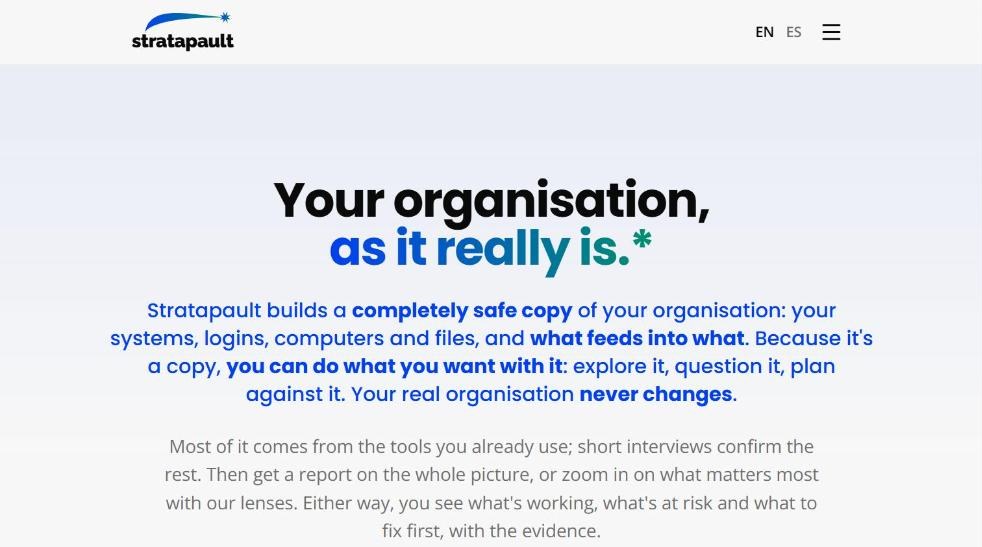
stratapault.com today
Why we were the right people to build it
Building it took a rare mix, earned the hard way: law, to read the rules first and bring that crucial attention to detail; 25 years building high-stakes systems that had to be right first time; an MBA from The Open University that showed how granular a business really is; and four years of building it. Few people have sat on both sides of the table like that, which put us in the best place to actually build it.
When generative AI arrived, we saw it could read the messy information organisations run on. So we broke organisations down to their smallest parts and mapped them in advance, instead of hoping an AI would work it out on the fly. The further you break it down, the more control you have.
The result is a digital twin of your organisation: a completely safe copy, built read-only from the tools you already use, that shows how it really runs compared with how it should, read with you by an experienced operator. Nothing is guessed; gaps are listed. It's the step our research says must come first: see the organisation before you change it.
"A vending machine, not a lucky dip."
Why we map an organisation in advance
One twin, then lenses
The twin is the wide shot: your whole organisation, mapped once. A lens is the zoom: one focused question asked of that twin and answered all the way down, with the evidence attached and a plan to fix what it finds. Add one lens or several; each builds on the twin you already have, so nothing is set up twice.
Is it safe to switch AI on?
Is Microsoft 365 or Google Workspace set up properly?
Who can still get in?
Who can see what?
Are our computers safe?
Would we pass Cyber Essentials?
Is our office network safe?
Your own standard, tested against your twin
What's inside: the tools behind the twin and the lenses
The twin and its lenses run on a set of tools we built over four years, and they come with me into the work. Each one is labelled honestly:
In useData mapping and analysis
Reads Microsoft 365, computers and networks, read-only, and turns files, email, devices and access into one picture of how you run.
In useChecks and a plan in order
Technical checks with the evidence attached, then a plan in order of priority and a Fix Pack of the changes to make.
In useDocumentation, written for you
Technology documentation across 35 areas: runbooks, suppliers, joiners and leavers. The handbook most organisations never had.
In useAI document sorting
AI labels documents and email, so you can see what you hold and where it lives.
In testingAsk your company
Ask your own organisation's twin a question in plain English and get an answer with its source shown.
BuiltOutside View
A free check of what anyone can see of your organisation from outside, released by an operator.
AI news filtered by sector and role, without filling your inbox.
In use: used on a real organisation · Built: finished and working inside our own business, ready for its first client · In testing: built, being tested before clients use it · Free: open to anyone · In development: being built now
My research: how organisations really work, and where AI fits
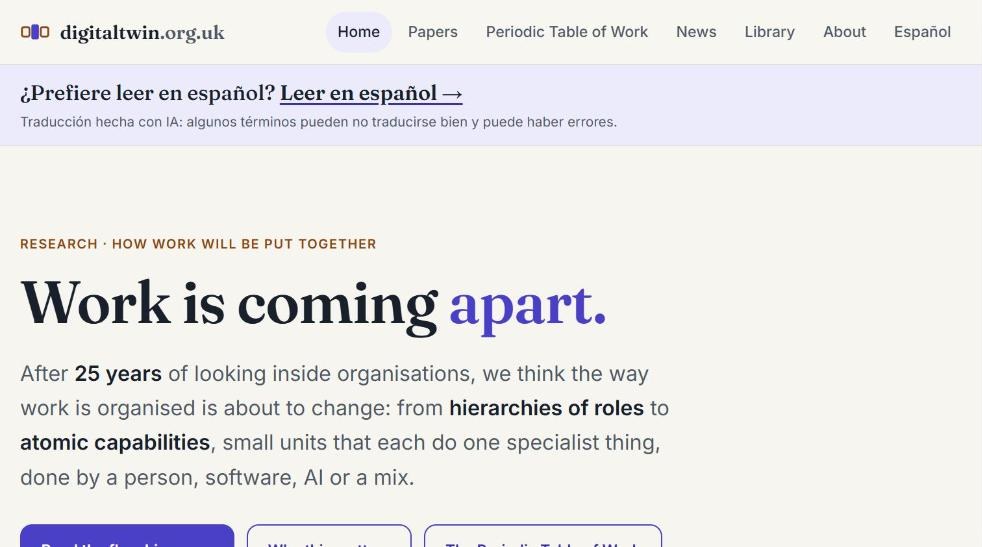
On digitaltwin.org.uk we publish the thinking behind the work, in the open, in English and Spanish. The argument: work is coming apart, from roles into atomic capabilities that take an input, transform it and hand on an output, done by a person, software, AI or a mix; capabilities will advertise themselves and serve one organisation or many; and no organisation can make that shift safely without first seeing itself, through a digital twin.
The papers are the chapters of a book written in public. The flagship, Work is coming apart, and Working Paper 1 are out; conversations on management, leadership, careers and education come next. Every paper is open for comment, and the best responses are published. Around them: a shared vocabulary, the Periodic Table of Work; our own cartoons, with the irony explained; and The Reaction, a weekly briefing.
Coming soonFollow our fascinating challenge: building a completely self-sustaining company, step by step, on YouTube and on digitaltwin.org.uk.
Forensic imaging for sexual assault referral centres
Challenge
Sexual assault referral centres (SARCs) care for victims and record evidence that may reach court. Images must be high quality, held securely and kept out of the patient's view.
What we did
With clinicians, we built Aspect, later Mayn Imaging: imaging hardware and self-contained software for SARCs and colposcopy, with burst capture, password-protected export and offline support.
Result
Sold to NHS trusts and police forces across the UK and Ireland. Still sold and supported.
Decision science · Imperial College
From a PhD project to a defence alliance
Challenge
An Imperial College PhD project had a method for very complex decisions, morphological analysis, and needed software to make it usable.
What we did
My team wrote the software. We researched the mathematical algorithms behind the method, turned them into requirements, then designed, built and tested it.
Result
The software went on to be used with several major clients, including a major international defence alliance: decision support where the stakes could not be higher.
Tempero, now part of Dentsu
Shifts and qualifications for social-media moderators
Challenge
The world's biggest social-media moderation company had to staff shifts only with people qualified for the work, such as safeguarding for a major broadcasting organisation's children's content.
What we did
We built a shift system with a planned rota and a "reality" rota, qualification checks, repeating shifts and leaver handover, exporting to finance. Designed in the same style as the spreadsheet the team already knew, so they switched over with no retraining and no disruption.
Result
Still in use after more than ten years, and I still support it.
Leading London advertising agency
From a ten-year SharePoint maze to AI-ready
Challenge
A leading London advertising agency, specialists in property, with ten years of sites and files that people struggled to navigate.
What I did
Mapped how work really flowed, then rebuilt the structure, naming and governance.
Result
Data ready for AI. They still trust me with their entire technology estate: Microsoft 365, devices, security and policies.
Public bodies
AI assistants with a person in control
Challenge
Use AI where answers carry legal weight.
What we did
We built a secure assistant that answers from a public body's own knowledge, and a tool that drafts case summaries from hearing audio.
Result
Drafts that judges review: a person stays in control.
Medical devices
An ECG device that detects stress
Challenge
Detect stress from the heart's rhythm, using heart-rate variability (HRV).
What we did
I ran the technical side as we built it: hardware, from a 3D-printed case to the electronics, and software for heart-rate mapping and HRV maths. I also handled the compliance and registration it needed before it could be used.
Result
A working device, tested on patients with 3-, 5- and 12-lead ECGs.
Twenty-five years of building things that matter
Stratapault
Founding member
Now
Four years in the making: a digital twin of how an organisation runs, read with a person. The full story is above, and more at the link below.
Technology consultancy for regulated and high-stakes work, including Mayn Imaging for NHS trusts and police forces, still supported today. Alongside it: business analysis, workflow and modernisation for healthcare, fintech and creative organisations.
Science One Innovation
Medical devices
2008 – 2011
Medical devices and embedded electronics, including ECG/EKG devices and their software.
e fortiori
My first technology consultancy · Founder
2002 – 2016
Created and grown the hard way: fixing computers first, then data and communications, then databases and systems for London creative agencies and PR companies, where the information was the business.
Then healthcare technology: I led developers, project managers and support teams across the full technology lifecycle: medical image capture, patient records, telehealth and remote monitoring, built to clinical standards (DICOM, HL7).
PIMS
Data and applications
1999 – 2001
Researcher on PR Organiser, a media-contacts database for PR newswires, using my languages; then managed the old database system and helped develop its new web version. Learned SQL Server and application development, and took my MCSE and MCDBA.
Law and languages
Where it started
The start
Law and Languages (French) at UWE Bristol, then a diploma in French law at the Université d'Angers in France, taught in French: the basis for my attention to detail.
Law, business and technology, always studying
It's an unusual mix, and it's deliberate. Law means I read the rules before the brochure: data protection, contracts, evidence, and now the law around AI. The MBA, from The Open University, keeps the work tied to what the organisation is trying to achieve. Hands-on delivery keeps the advice practical, not a slide deck.
Law and Languages (French), LLBUWE Bristol
Diploma in French lawUniversité d'Angers, taught in French
MBA in Technology ManagementThe Open University, with Merit
MCDBAMicrosoft Certified Database Administrator, SQL Server
Currently studying: Understanding and Achieving Compliance With European Union Artificial Intelligence ActKeeping up as new rules and guidance come into force.
Always studying. Recent areas and courses:
AI engineering and agents (LLMs, RAG, MCP)
Microsoft Copilot Studio
The EU AI Act and AI ethics
CompTIA Security+ and CySA+
Microsoft 365 security admin (MS-102)
Data management and data governance
Business analysis
What people say
Ask about my work
Questions about my experience, services or Stratapault? My AI assistant answers from my approved profile, and says so when it doesn't know.